English
 عربى
 Español
 中文简体

Content
- 1 How a Pulse Jet Baghouse Cleans Air Without Going Offline
- 2 Efficiency Metrics That Predict Pulse Jet Baghouse Performance
- 3 Filter Bag Life: Why Bags Fail Prematurely and How to Prevent It
- 4 High-Temperature Filter Media Options for Pulse Jet Baghouses
- 5 Design Choices That Decide Retrofit Cost and Operating Cost
- 6 A Pulse Jet Baghouse Maintenance Schedule That Prevents Downtime
- 7 Frequently Asked Questions About Pulse Jet Baghouses
When a gray iron foundry replaced its aging shaker-type collector with a pulse jet baghouse, stack emissions dropped from 38 mg/Nm³ to 6 mg/Nm³ in the first week of operation. That result is typical: a well-designed pulse jet baghouse holds outlet concentrations below 10 mg/Nm³, and premium filter media often reach 5 mg/Nm³ or lower. For plant managers and EHS engineers, it is the most widely adopted fabric filter technology because it cleans continuously at higher filtration velocity than shaker or reverse-air units.
Two compliance facts: a correctly tuned pulse jet baghouse collects 99.9% of particles down to 0.5 micron and keeps outlet dust below 10 mg/Nm³ without compromising production uptime.
This guide covers the working principle, efficiency metrics, high-temperature filter media, retrofit design decisions, and the maintenance routine that keeps a pulse jet baghouse at design efficiency.
How a Pulse Jet Baghouse Cleans Air Without Going Offline
A pulse jet baghouse cleans its bags in place by firing a short, high-pressure burst of compressed air into each bag opening; the shock wave flexes the fabric, cracks the dust cake, and gravity drops the material into the hopper. Each cleaning cycle takes less than 0.3 seconds per row, so filtration never stops.
Four components work together in every cycle:
- Filter bags on wire cages, hung from a tubesheet that separates the dirty and clean gas chambers.
- A pulse valve and blowpipe above each row, delivering 0.5 to 0.7 MPa compressed air into the bag mouth.
- A hopper with a rotary valve or screw conveyor that discharges collected dust continuously or in batches.
- A controller that fires valve rows in sequence, triggered by differential pressure, a timer, or both.
Definition: A pulse jet baghouse is a fabric filter dust collector that cleans bags in service by directing a short burst of high-pressure compressed air into the bag opening, creating a shock wave that flexes the fabric and releases the dust cake without interrupting filtration.
The dust cake does the fine filtration; the fabric is the support structure. Pulse cleaning must remove excess cake without stripping the bags bare.
Efficiency Metrics That Predict Pulse Jet Baghouse Performance
Outlet emission, air-to-cloth ratio, and pressure drop decide whether a pulse jet baghouse will comply, and all three are fixed at the design stage. Get them wrong on paper and no maintenance program can fix the unit.
below 10 mg/Nm³Guaranteed outlet emission with proper media
99.9%+Collection efficiency on sub-micron dust
2.0–3.5 m/minGross air-to-cloth ratio for pulse jet fabric
1.0–1.8 kPaNormal operating pressure drop across bags
Air-to-cloth ratio is the most common design error. A pulse jet baghouse runs at 2.0 to 3.5 m/min — two to three times faster than reverse-air units — but exceeding the dust-specific value pushes pressure drop up and bag life down. The table gives starting points for common dust classes.
| Dust class | Air-to-cloth ratio (m/min) | Typical outlet (mg/Nm³) |
| Foundry sand and casting dust | 2.0 – 2.5 | 5 – 10 |
| Coal and ash handling | 2.0 – 3.0 | 10 – 20 |
| Cement and lime | 1.8 – 2.2 | 10 – 20 |
| Welding fume and metal oxide | 1.5 – 2.0 | 1 – 5 |
Trend pressure drop: a sudden rise signals a burst bag, plugged pulse valve, or moisture problem; a gradual rise over months means cleaning intensity is too low or the media is blinding.
Rule of thumb: design for 1.0 to 1.8 kPa at normal load. If differential pressure holds above 2.0 kPa, investigate before the cleaning system shortens bag life.
Filter Bag Life: Why Bags Fail Prematurely and How to Prevent It
A well-specified pulse jet baghouse keeps bags in service for two to five years, and most premature failures come from four correctable causes: wrong media, over-cleaning, moisture, and abrasive dust recirculation.
- Temperature spikes above the media rating shrink synthetic fabrics; install a high-temperature bypass or conditioning damper.
- Acid dew point corrosion attacks bags and cages near the dew point; insulate the housing and keep at least a 20°C margin.
- Aggressive pulse pressure strips the dust cake and drives fine particles into the media, where they blind permanently.
- Hopper bridging lets collected dust rest against bag bottoms, abrading the fabric at the seal area.
Bag selection starts with gas temperature and chemistry, not price. Confirm continuous and peak temperatures, sulfur or chloride content, and moisture load before choosing among polyester, aramid, polyimide, or PTFE media. A bag that fails after eight months because it was specified for 120°C in a 180°C stream costs far more than the media savings.
Every 10°C above the continuous media rating roughly halves bag life. A polyester bag rated at 130°C will not survive an inlet that regularly reaches 150°C.
High-Temperature Filter Media Options for Pulse Jet Baghouses
Continuous operating temperature is the first media selection criterion because exceeding it is the fastest way to destroy a baghouse investment. The chart below compares maximum continuous service temperatures for the six most common filter media families.
Maximum continuous operating temperature of baghouse filter media
Values represent continuous dry gas service; peak allowances and chemical resistance must be checked against the actual gas analysis.
Gas chemistry matters as much as temperature. PTFE combines 260°C tolerance with near-total chemical resistance but costs more than aramid. P84 polyimide filters fine particles well but degrades in strong acids. Treated fiberglass remains the economic standard for high-volume utility and steel service.
Woven fiberglass
Handles 260°C with acid-resistant finish; sensitive to mechanical flexing, so pulse pressure and frequency must be reduced; lowest cost per square meter.
P84 and PTFE felts
Superior fine particle capture and chemical tolerance; higher initial cost but longer life in demanding high-temperature or chemical service.
Design Choices That Decide Retrofit Cost and Operating Cost
Air-to-cloth ratio, hopper geometry, clean-side access, and compressed-air capacity decide whether a pulse jet baghouse performs over its whole life. For retrofits, the existing footprint is the constraint that pushes plants toward compact configurations.
For new installations, a flat-bag pulse jet collector with a modular hopper, walk-in clean-air plenum, and top bag removal gives the lowest maintenance cost. Changzhou Thinks Environmental Technology Co., Ltd. builds the TD-Series flat-bag pulse jet dust collector around this service concept, with clean-side bag change-out and independently tunable pulse rows per zone.
 TD Series Flat-Bag Pulse Jet Dust CollectorThis modular pulse jet collector uses side-insert flat bags and clean-side change-out, suited for new installations with good dust flowability at 8,000–40,000 m³/h. Its walk-in plenum and independent pulse rows support low maintenance.View Product →
When a plant must fit more filter area into an existing footprint, compact bag geometry makes the difference. The TDC Compact version of the TD series reduces plan area while keeping pulse jet cleaning performance, which is why retrofit projects should evaluate a compact pulse jet baghouse before enlarging the building.
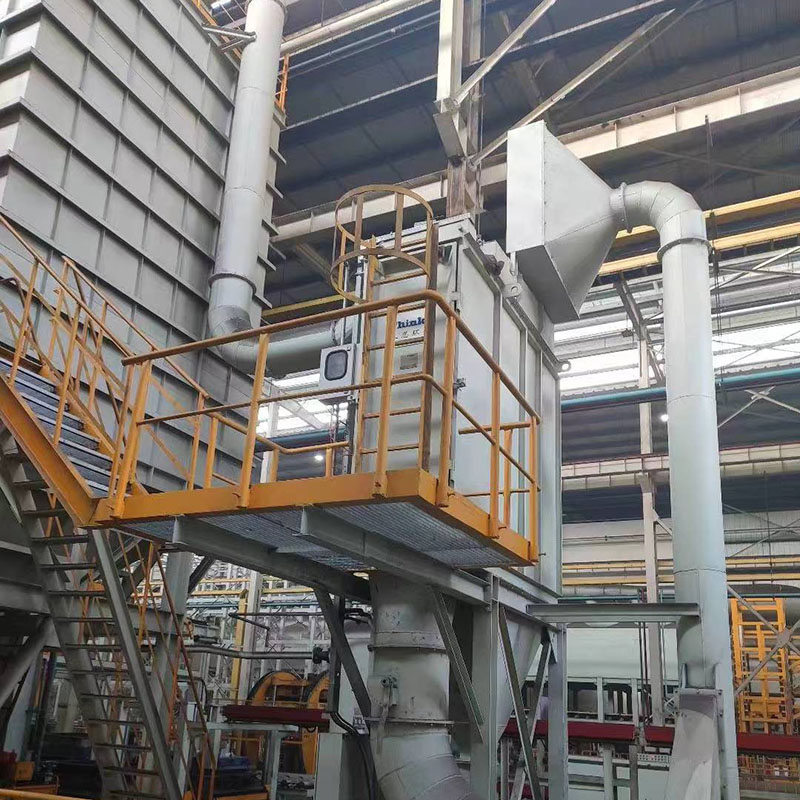 TDC Compact Pulse Jet Baghouse for Limited SpacesWith the same flat-bag cleaning technology but a reduced footprint, this unit handles 1,000–8,000 m³/h, making it a practical choice for retrofit projects where floor space is tight and filter area must be expanded.View Product →
For foundry and metal casting lines, inlet gas is often hot and carries sparks, so the design needs a spark catcher or cooling duct ahead of the bags. Practical guidance for these conditions is covered in the foundry dust extraction and filtration solutions section.
Retrofit reality: compact pulse jet designs deliver the same filter area in roughly one-third less plan footprint — often the difference between a retrofit and a new building.
A Pulse Jet Baghouse Maintenance Schedule That Prevents Downtime
Roughly 90% of baghouse failures are preventable with a weekly, monthly, and quarterly routine that takes about four hours per month on a typical 20-row unit.
Weekly: log pressure drop and stack appearance
Trend differential pressure at the same production load. A jump of 0.3 kPa within 48 hours points to a burst bag or a stuck pulse valve.
Monthly: inspect pulse valves and moisture drains
Fire each valve manually and listen for a sharp snap; a hissing valve wastes compressed air and leaves one row uncleaned. Drain hoppers and check discharge parts.
Quarterly: verify seals, cage alignment, and bag tension
Dust on the clean side of the tubesheet usually means a failed bag seal, not a torn bag; replace seals before bags.
Annually: run a full bag and cage audit
Look for bottom abrasion, acid attack, and chemical stiffening. Replace bags in sets to keep pressure drop balanced across rows.
Critical warning: after pressure drop stabilizes, switch from fixed-timer to differential-pressure-triggered cleaning with a high-pressure alarm, so the pulse jet baghouse cleans only when needed.
Compressed air quality is the hidden variable. Oil carryover coats and blinds fabric permanently; install a coalescing filter and dryer upstream if the supply is shared with lubricated equipment. For replacement intervals on valves, diaphragms, and solenoid coils, follow the pulse jet baghouse maintenance guide.
Frequently Asked Questions About Pulse Jet Baghouses
How long do pulse jet baghouse bags last?
With correct media selection and normal operating conditions, filter bags typically last two to five years. Failures within the first year are almost always caused by temperature excursions, chemical attack, over-aggressive cleaning, or moisture.
What is the right air-to-cloth ratio for a pulse jet baghouse?
Design for 2.0 to 2.5 m/min gross air-to-cloth ratio for most industrial dusts; use 1.5 to 2.0 m/min for fine or sticky dust such as welding fume, and up to 3.0 m/min for coarse dust like fly ash. Base the number on actual particle size distribution, moisture, and temperature.
Can a pulse jet baghouse handle high-temperature flue gas?
Yes, up to 260°C continuous with P84, PTFE, or treated fiberglass media. Above 260°C, add a gas cooling step such as a dilution air damper or radiant cooler before the baghouse.
How do I know when a pulse valve needs replacement?
If differential pressure rises while the controller shows normal pulse activity, check the valve diaphragms. Valves that hiss, fire weakly, or fail to reseat should be replaced; typical diaphragm service life is one to three years depending on compressed air quality.
Bottom line: the pulse jet baghouse is the most forgiving fabric filter technology when designed around real gas data — and the most expensive one to misapply. Define the gas conditions first, then the baghouse, and plan the maintenance before commissioning.