English
 عربى
 Español
 中文简体

Inside a machining hall with twenty CNC lathes running at 6,000 rpm, the air can hold 5 to 10 mg/m3 of oil aerosol on a busy shift, several times the 0.5 mg/m3 reference value that NIOSH recommends for mineral oil mist. The source is everywhere at once: coolant sprayed into a rotating tool, chips crashing through the fluid, and fine droplets riding the heated air plume out of the cutting zone. An oil mist recovery system changes the equation by capturing that aerosol near the source, coalescing it back into liquid, and routing reusable oil to the machine sump.
What an Oil Mist Recovery System Does
A recovery system starts with extraction, not filtration. The hood position, air volume, and pressure balance decide how much mist actually reaches the filter, and therefore how much oil returns to the sump.
In process terms, an oil mist recovery system is a self-contained filtration unit that removes oil aerosols from the machining environment, coalesces them into liquid, and returns a large share of that liquid to the cutting fluid circuit while releasing cleaned air into the shop or outdoors.
How the Recovery Loop Works
Every oil mist recovery system follows the same three-stage sequence: capture, coalesce, and return.
Capture. A suction hood or machine enclosure port draws aerosol away from the cutting zone at a capture velocity of at least 0.5 m/s. Any lower, and droplets drift past the hood and into the breathing zone.
Coalesce. Oil-laden air passes through a cyclonic pre-separator and then fibrous coalescing media, where fine droplets merge into larger ones, fall out of the airstream, and drain into a collection tray.
Return. The collected liquid settles in a small tank, where tramp oil and swarf are separated, before a pump sends the reusable coolant back to the machine sump.
This closed loop changes coolant economics. Precision machining shops with multiple machining centers typically report a 20 to 40 percent reduction in coolant top-up volume within the first year of running a recovery system, because the oil that previously became sticky film on walls, ceilings, and machine panels is returned to the process instead.
Differential pressure is the single most reliable maintenance signal. A new coalescing filter starts near 250 Pa. When the reading crosses about 750 Pa, reinstall or replace the media without waiting for a calendar date.
Comparing Oil Mist Recovery System Technologies
No single technology handles every droplet spectrum, so the practical choice depends on particle size, airflow, and how clean the return oil must be.
| Technology | Effective Particle Range | Collection Efficiency | Maintenance Interval | Best Fit |
| Centrifugal / Cyclone | Above 2 micron bulk mist | 85-95% on larger droplets | Low, drain only | Pre-separation and high-load first stage |
| Coalescing Fibrous Media | 0.3 to 10 micron | Up to 99% at MERV-15 | Media change at 6-12 months | Standard CNC oil mist and coolant spray |
| Electrostatic Precipitator | 0.01 to 1 micron submicron | 90-98% with regular collector wash | Wash collection cells every 1-3 months | Very fine grinding mist and high air volumes |
| HEPA Final Filter | 0.3 micron and above | 99.97% DOP | Annual replacement typical | Final discharge for recirculated air |
Many packaged systems combine two stages, for example a cyclonic pre-separator followed by coalescing media and a HEPA guard. That arrangement protects the expensive final filter from sticky overload and keeps discharge air clean enough to return to the plant without makeup air credits.
99.97%
HEPA efficiency at 0.3 micron, the standard final-stage rating
0.5 mg/m3
NIOSH reference level for mineral oil mist, a common risk benchmark
60-95%
of collected aerosol can be coalesced and returned to the sump
250 Pa
typical initial pressure drop across new coalescing media
Right-Sizing an Oil Mist Recovery System
Right-sizing an oil mist recovery system starts with the flow rate at the point of capture, not the volume of the machine hall. Each hood opening is sized by hood face area times capture velocity, and the fan must hold that velocity at every hood at the same time.
- Air volume. Calculate each hood opening in square meters and multiply by 0.5 m/s capture velocity. Sum the branches and add 15 percent for duct losses.
- Particle spectrum. Coolant spray from a lathe ranges mostly from 0.5 to 10 micron. Grinding mist goes farther into the submicron range, which favors an electrostatic stage.
- Oil viscosity. High-viscosity oils coat media faster and require more frequent cleaning, so factor oil type into the filter area before finalizing the unit.
- Space and ductwork. Branch runs over 15 to 20 meters add pressure loss and give oil film a surface to deposit on.
- Return oil quality. Bacteria and tramp oil degrade coolant, so the recovery unit needs a coalescing tank or skimmer before the sump.
Central System
One fan and filter bank serves five to ten machines through duct branches.
Best for crowded shop floors where individual units would block access or interfere with overhead cranes. Ductwork adds installation cost and must be drained regularly.
Machine-Mounted Unit
A dedicated recovery unit sits on or beside each machine and runs only when the machine runs.
Best when machine layouts change, when coolant types differ, or when return oil must stay segregated by product line.
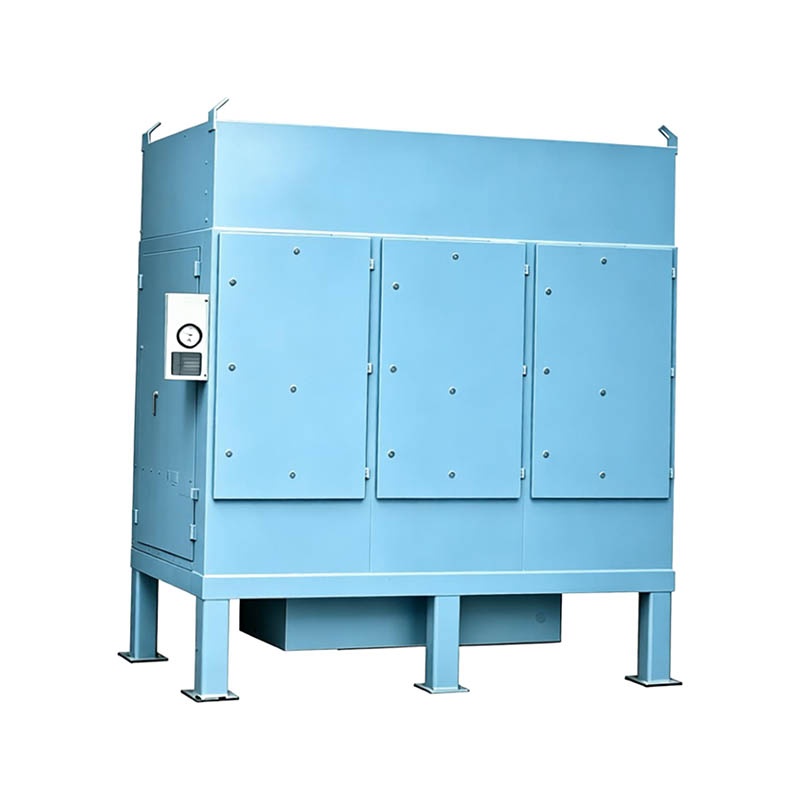
For a packaged machine-mounted solution, Changzhou Thinks Environmental Technology Co., Ltd. supplies the TEM Series Oil Mist Processor with integrated coalescing and HEPA stages. The series is built for single-point capture on lathes, grinders, and machining centers, with airflow options matched to the machine enclosure rather than the whole shop.
 TEM Series Oil Mist Processor for MetalworkingThe TEM Series Oil Mist Processor captures oil mist, water mist, and dust from machining operations, using modular multi-stage filtration and reusable self-cleaning filters. It is suited for single-point capture on lathes, grinders, and machining centers, and pairs with broader dust collection systems.View Product →
When a plant needs extraction beyond oil mist, the same sizing logic extends to dry dust and fume sources. Combining oil mist recovery with general dust collection keeps one maintenance team and one set of spare parts rather than two parallel systems.
Maintenance Practices That Preserve Oil Mist Recovery Efficiency
The recovery rate a system delivers in its first month is not the rate it keeps if filters are run past their pressure drop limit. A planned routine built around measured pressure loss protects both efficiency and air quality.
| Task | Frequency | Warning Sign | Impact if Skipped |
| Empty the pre-separator drain | Weekly | Oil pooling in the drain line | Droplets re-entrain into the airstream |
| Check return line valves | Weekly | Air lock in the return line | Recovered oil never reaches the sump |
| Measure differential pressure | Monthly | Reading above 750 Pa | Filter bypass and rising stack emissions |
| Replace coalescing media | Pressure-based | Sustained 750 Pa or heavy oil carryover | Collection efficiency drops below 80% |
| Inspect HEPA final filter | Quarterly | Oily residue on the outlet grille | Cleaned air recirculates with oil |
750 Pa is the actionable replacement threshold for most coalescing media. Log the reading after each filter change, and treat the limit as the trigger for service instead of relying on months on the clock.
Filter life depends more on oil load than on time. A system on a roughing operation with heavy flood coolant can load media in four months; the identical unit on a light finishing line may run for a year. That is why pressure-drop-based intervals outperform blanket schedules.
Oil Mist Recovery System FAQs
Quick decision rule: if an airflow estimate is based on hall volume rather than hood face area, re-run the calculation before requesting quotes. Undersized hoods are the most common reason recovery systems underperform.
How much oil can an oil mist recovery system return to the machine?
With properly positioned hoods and balanced airflow, 60 to 95 percent of the aerosol that reaches the filter can be coalesced and returned to the sump. The exact share depends on coolant temperature, nozzle pressure, and whether the cutting zone is enclosed. Shops typically report top-up savings of 20 to 40 percent in the first year.
What particle sizes does an oil mist recovery system capture?
A two-stage system with coalescing media and a HEPA guard captures particles from 0.3 micron upward, which covers most coolant spray and grinding mist. For submicron particulates below 0.3 micron, an electrostatic stage is the more effective choice.
Can one central system serve a whole machining shop?
A central unit can serve five to ten machines if branch duct lengths stay under 15 to 20 meters and dampers balance the airflow. Longer runs increase fan energy and create surfaces where oil film and bacteria accumulate, which is why machine-mounted recovery is preferred when layouts change.
How often must filter media be replaced?
Replace coalescing media when differential pressure crosses roughly 750 Pa, which at moderate oil loads usually falls between 6 and 12 months. The HEPA final filter typically lasts 12 to 18 months, but inspect it quarterly for oily residue.