English
  عربى
عربى  Español
  中文简体
中文简体

Content
- 1 What Air Pollution Control Equipment Actually Does
- 2 Main Equipment Families and Where Each One Fits
- 3 Gas and VOC Control Completes the Picture
- 4 Selection Criteria That Decide Success or Failure
- 5 How Industries Apply the Same Equipment Differently
- 6 The Collector Is Only Half the System
- 7 What to Verify Before You Buy
A plant engineer responsible for a foundry's emission compliance rarely asks for "a dust collector" in the abstract. The real conversation starts with a problem: baghouse pressure drop climbing every week, cartridge media plugging in humid weather, or a new particulate limit that the existing unit cannot meet. Air pollution control equipment is the umbrella term for the systems that solve these problems, but the right answer depends on matching the collection technology to the pollutant, the process, and the operating conditions. This article explains the main equipment families, the trade-offs in choosing them, and the practical points that determine whether a system runs reliably for years or creates maintenance problems from the first month.
What Air Pollution Control Equipment Actually Does
Every industrial air pollution control system performs four steps in sequence:
- Capture contaminated air at the source with a hood or enclosure.
- Convey it through ductwork to the treatment device.
- Separate the pollutant from the air stream using filtration, scrubbing, or oxidation.
- Return the cleaned air to the workplace or release it through a stack.
The separation step is where equipment types diverge, because the physical form of the pollutant dictates which mechanism works. Dry dust needs a filter or a momentum-based separator. Sticky or combustible dust often needs water. Oil mist requires coalescing media. Gases and volatile organic compounds (VOCs) need adsorption or thermal destruction.
| Pollutant form | Typical sources | Equipment families |
|---|---|---|
| Dry particulate, powders | Shot blasting, sand handling, grinding, conveying | Flat-bag and baghouse filters, cartridge collectors, cyclones, electrostatic precipitators |
| Moist, sticky, or combustible dust | Polishing, aluminum and magnesium processing | Wet dust collectors, explosion-proof wet scrubbers |
| Oil mist and aerosols | Metal cutting, machining, cold rolling | Oil mist collectors |
| Gases and VOCs | Printing, coating, chemical reactions, drying | Thermal and catalytic oxidizers, activated carbon adsorption |
| Hot gas with sparks and embers | Melting furnaces, welding, plasma cutting | Spark catchers and air coolers upstream of fabric or cartridge filters |
Getting this classification right matters more than brand choice. A fabric filter that handles dry foundry sand well can be blinded within weeks by sticky aluminum polishing dust, and a wet scrubber installed where a dry collector would have sufficed simply adds water treatment cost without improving performance. The selection process should therefore begin with a written pollutant profile, not with a product catalog.
Main Equipment Families and Where Each One Fits
Fabric filters and cartridge collectors
Fabric filters, including flat-bag and baghouse designs, use woven or felted media to capture dry particulate. Pulse-jet cleaning releases a burst of compressed air through the bags while the fan continues running, which suits continuous processes such as foundry sand handling or steel grinding. Cartridge collectors use pleated media to pack more filtration area into a smaller footprint and generally achieve better collection efficiency on fine dust from 0.5 to 5 microns. The trade-off is that cartridge elements cost more per unit and can be damaged by abrasive or hygroscopic dust. A TMC series cartridge dust collector is an example of a compact cartridge system designed for moderate dust loads and limited floor space; in practice, the choice between fabric and cartridge media comes down to available space, dust fineness, and acceptable filter replacement cost.
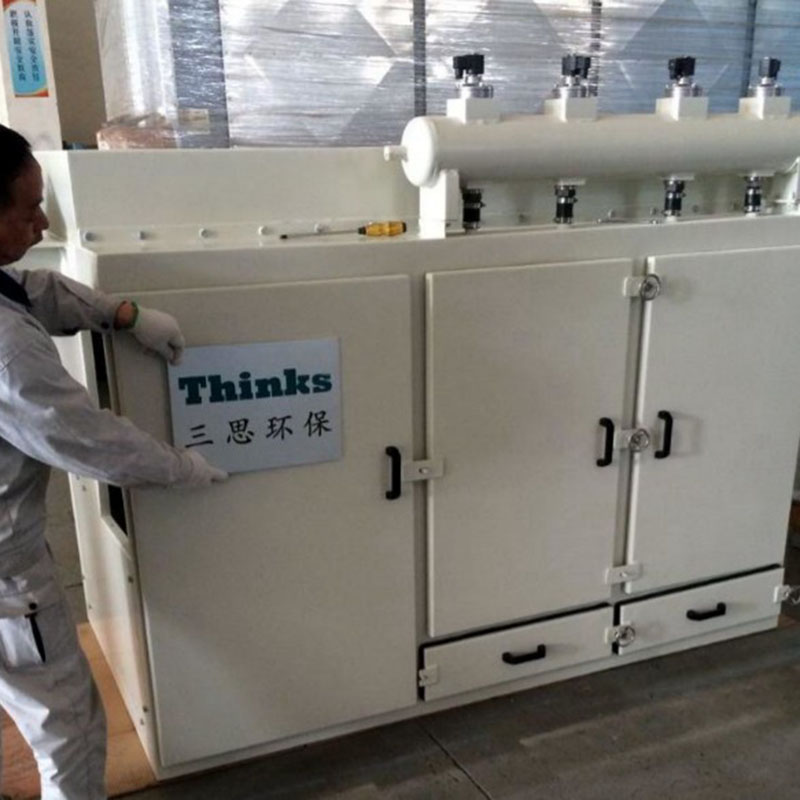 Wholesale TMC Series Cartridge Dust Collector Manufacturer, FactoryChangzhou Thinks Environmental Technology Co., Ltd is China Wholesale TMC Series Cartridge Dust Collector Manufacturer and OEM/ODM Factor...View Product →
Wet collectors and explosion-proof designs
Wet dust collectors use water to capture and wash out the contaminant. They become the preferred option when the dust is sticky, when the gas stream contains soluble components, or when an ignition risk is present. For combustible metal dust such as aluminum, magnesium, or titanium, an explosion-proof wet collector is often the most defensible configuration because the dust is wetted before it can accumulate on a dry filter surface. A TVC series explosion-proof wet dust collector addresses this duty and must be evaluated together with the duct layout and spark-producing sources, because explosion protection is a system property, not a single component.
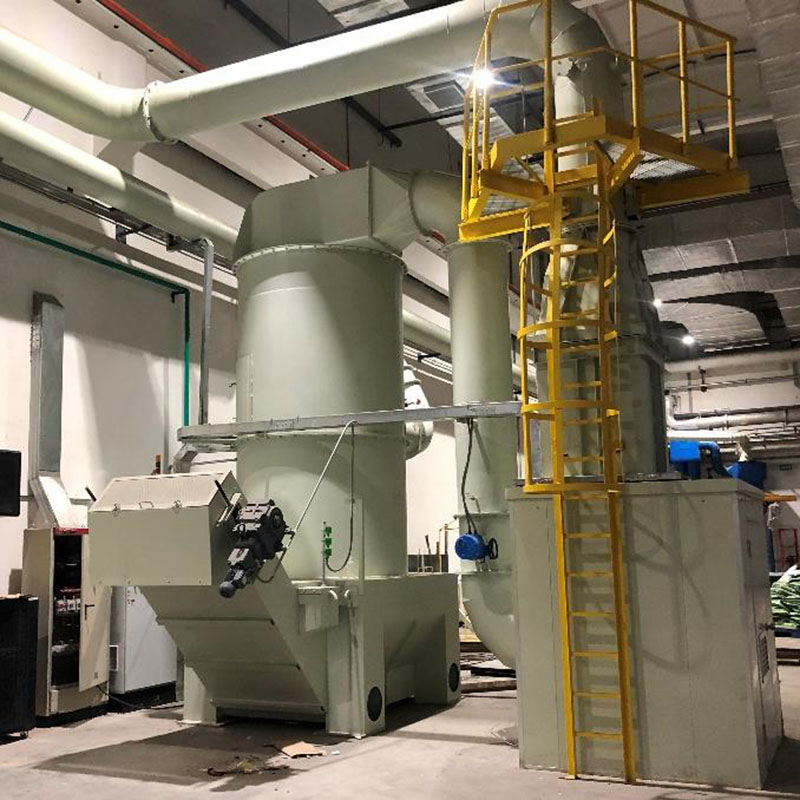 Wholesale TVC Series Explosion-Proof Wet Dust Collector Manufacturer, FactoryChangzhou Thinks Environmental Technology Co., Ltd is China Wholesale TVC Series Explosion-Proof Wet Dust Collector Manufacturer and OEM/...View Product →
Oil mist collectors and high-vacuum cleaning systems
Oil mist collectors use coalescing filters to remove aerosols generated by metalworking fluids, protecting both worker health and plant cleanliness in machining areas. High-vacuum dust collection systems occupy a different niche: a central vacuum network that cleans floors, equipment surfaces, and hard-to-reach corners directly at the point of generation, which is valuable in facilities that handle fine, valuable, or hazardous powders.
Gas and VOC Control Completes the Picture
Particulate control receives most of the attention in industrial air quality projects, but many factories must also handle solvent vapors, chemical fumes, or odor. Thermal oxidizers destroy VOCs at high temperature, while catalytic oxidizers operate at lower temperatures and consume less fuel. When solvent concentration is low or intermittent, activated carbon adsorption combined with catalytic combustion is often more economical than a full oxidizer running continuously. For streams containing both particles and VOCs, the design sequence normally places particulate collection first and gas treatment second, protecting the adsorption or catalyst media from fouling. An activated carbon adsorption desorption and catalytic combustion system illustrates this combined approach for facilities with fluctuating solvent loads, from printing lines to coating operations.
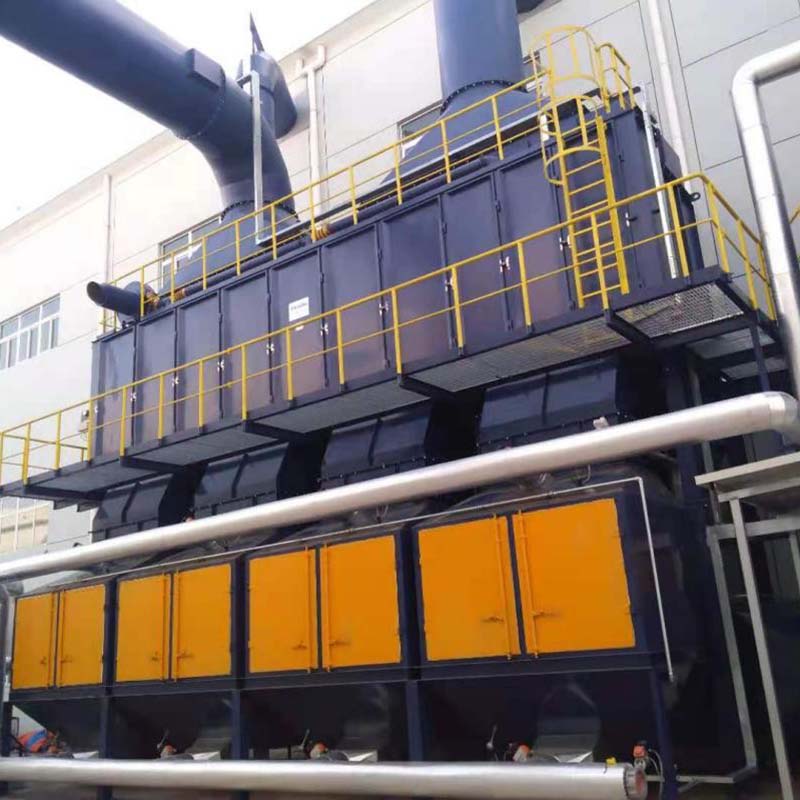 Wholesale Activated Carbon Adsorption, Desorption, and Catalytic Combustion SystChangzhou Thinks Environmental Technology Co., Ltd is China Wholesale Activated Carbon Adsorption, Desorption, and Catalytic Combustion S...View Product →
Selection Criteria That Decide Success or Failure
Start with the dust and gas characteristics
Particle size distribution, bulk density, abrasiveness, moisture, temperature, and explosibility determine which collector family can work at all. Hygroscopic dust can blind pleated cartridge media in humid climates; abrasive dust erodes duct elbows and cyclone walls long before it reaches the filter; and gas above roughly 200°C requires high-temperature filter media or an upstream cooling stage. A reputable supplier will ask for these parameters in writing before quoting, because every downstream performance guarantee depends on them.
Match air volume, filtration velocity, and emission limits
Air volume drives the size of every component from duct diameter to fan power. Filtration velocity, the ratio of air flow to filter area, is the number that separates a reliable collector from a chronic maintenance problem. Run a cartridge collector above its rated velocity and the differential pressure rises, the cleaning cycle shortens, and media life collapses. The practical trade-offs between the two dominant filter technologies are covered in this cartridge vs baghouse comparison, but the short version is: cartridges save space and handle fine dust well; baghouses tolerate higher dust loads and abrasive particles at a lower media cost.
Check safety codes and compliance boundaries
Local emission limits, workplace exposure limits, and explosion protection standards such as ATEX or NFPA 68 define the design envelope before any hardware is selected. Equipment that meets a stack emission limit can still fail a safety review if dust accumulates inside the ductwork and creates a deflagration risk. Explosion venting, isolation valves, and spark detection must be considered as part of the whole system, especially in industries processing combustible powders.
How Industries Apply the Same Equipment Differently
Foundries, steel plants, nonferrous metal processors, chemical plants, pharmaceutical facilities, and new energy manufacturers buy the same broad categories of equipment, but each applies them around a different set of constraints. A gray iron foundry typically installs a flat-bag collector for melting and sand handling, then adds a spark catcher and an air cooler before the filter on a shot blasting line. A pharmaceutical plant processes small batches of potent compounds and therefore prioritizes cartridge collectors with safe, fast filter change-out and HEPA final filtration. A printing plant's dominant problem is solvent vapor rather than dust, which shifts the budget toward VOC abatement. For a closer look at one of the most demanding sectors, the foundry dust collection solutions page explains how dust loads from casting, shakeout, and finishing are translated into specific equipment arrangements.
| Industry | Primary pollutants | Common equipment |
|---|---|---|
| Foundry | Sand dust, metal fume, smoke | Flat-bag collectors, spark catchers, air coolers |
| Steel and metallurgical plants | Fine fume, hot gas, scale dust | Baghouse filters, cartridge collectors, wet collectors |
| Nonferrous processing | Combustible dust, acid gas | Explosion-proof wet collectors, scrubbing systems |
| Chemical plants | Powders, VOCs, process gas | Cartridge collectors, carbon adsorption, catalytic oxidation |
| Packaging and printing | Solvent vapor, paper dust | Activated carbon systems, thermal and catalytic oxidizers |
| Pharmaceutical | Potent dust, solvent vapor | Cartridge collectors, HEPA filters, carbon systems |
The Collector Is Only Half the System
A correctly sized collector still underperforms when the upstream capture and pretreatment are wrong. Source capture hoods must be positioned to catch the contaminant without dragging excessive process material into the duct. Spark catchers protect filter media from glowing embers. Air coolers reduce gas temperature to protect media and prevent smoldering. Duct velocity must be high enough to prevent dust settling but low enough to limit erosion. These components are often the difference between an installation that passes its acceptance test and one that struggles every shift. Suppliers that also provide hoods, spark traps, coolers, and startup support eliminate the interface problems that appear when several vendors each blame the other; the dust collection system service and setup support offered by an integrated manufacturer is one way to verify that a vendor can handle the complete scope.
What to Verify Before You Buy
The headline price per cubic meter of air flow is a poor basis for comparison. Total cost of ownership depends on filter media life, compressed air consumption, fan energy, disposal cost of collected dust, and downtime during filter changes. Before signing a quotation, confirm that the supplier has documented the design assumptions:
- Inlet dust concentration, particle size distribution, temperature, and moisture content.
- Required outlet emission limit and the test method that will be used at commissioning.
- Filter media type, rated filtration velocity, and expected service life.
- Compressed air quality and consumption for pulse-jet cleaning.
- Factory testing, installation supervision, operator training, and spare parts response.
Manufacturing capability matters in this evaluation as much as the datasheet. A supplier behind its own factory is accountable for welding quality, casing thickness, and the alignment of doors and hoppers. International delivery experience is equally relevant: when equipment is exported, project handling, documentation, and local support determine how quickly the system starts producing. The plant behind the equipment families described in this article operates on a 22,000 m² factory floor, sells more than 15% of its output overseas, and supports projects through offices in Mexico and Russia. That kind of footprint does not guarantee a good installation, but it makes the practical support questions easier to answer. Air pollution control equipment works when it is selected for the pollutant, sized for the process, and supported for the life of the system.